
No products in the cart.
Romeo is a Dead Man – Suda 51 and director Ren Yamazaki discuss controlled chaos of development Leave a comment
Hey PlayStation Blog readers, ever hear the story of the FBI Space-Time Police Special Agent Romeo, who takes down space-time criminals in search of his lost girlfriend? No? Well, you’ll be able to find out when Romeo is a Dead Man launches on February 11!
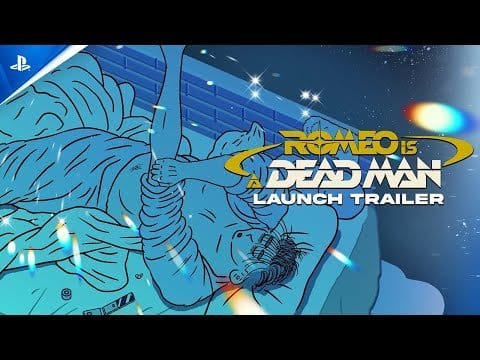
We’ve uploaded one final trailer for you all today featuring some brand new music that’ll be in the game. Seeing is believing as they say, so take a good hard look.

As you can see we’re getting some pretty serious artists to contribute to the game’s soundtrack, further reinforcing Romeo is a Dead Man as a dead-serious action-adventure game. How serious exactly? Well, we asked Grasshopper Manufacture CEO, director, and scenario writer Goichi Suda (pictured left) and co-director and scenario writer Ren Yamazaki (pictured right) to find out.

The character clicked as soon as they realized Romeo was also DeadMan
Daisuke Koyama: Is the game based on Shakespeare’s play? What made Romeo’s story take the form it has now?
Goichi Suda: It’s not entirely based on Shakespeare, no. The protagonist was always named Romeo, and if we were going to include a character named Juliet at all we figured it’d be something of a cameo at first. While writing the script, though, we noticed she became more of an important character as it went along.
Romeo and his grandfather Ben are pretty clearly based on the old man/young man dynamics you see in Back to the Future or Rick and Morty, and we originally figured it would be about their journeys through space-time. But when we threw Juliet in there, it was like a missed connection or something slowly taking shape into a full-blown relationship. In other words, we never really thought too hard about making this into a “tragedy” like the original play.
So Suda-san originally came up with the character of Romeo and wrote the basic scenario for the game, and then Yamazaki-san turned it into a full script, right? What kind of character is Romeo to you?
Ren Yamazaki: Compared to previous protagonists Suda has written, I think he’s quite a serious and straightforward character with no hidden agenda.
Suda: I wanted to write the story of a good-natured young man maturing over time. Travis, the protagonist of the last scenario I wrote—No More Heroes 3—had a wild and violent journey, so I wanted a protagonist who’d be the exact opposite of that.
He ended up being a masked protagonist, too.
Suda: I always wanted Romeo Stargazer to be a character that left a strong impression not just through his in-game skills and weapons, but as a character too. Our past titles feature all sorts of characters who are loved by gamers, so I really thought hard about how to make Romeo a character who’d be just as praised. When Romeo got the DeadMan moniker along the way, he really started to come to life in a way that made me confident in him. I thought to myself, like, “Romeo really is DeadMan!” and then it all kind of fell into place. That’s why we made it the title, too.

The action itself is quite the strong-style hack-and-slash, isn’t it?
Yamazaki: Yeah, I was firm about that. So many different aspects and systems of the game changed throughout development, but in my discussions with our main programmer, Hironaka, we made sure the battle system delivered a strong sense of action from the beginning to the end of development.
How’s the combat balanced?
Suda: In a full course dinner, the ingredients used are usually pretty standard no matter where you go, right? Looking at this game’s development as a full course meal, when it comes to graphics, sound design, and also the actual gameplay, we ended up using all sorts of ingredients that you normally wouldn’t find in a regular kitchen. But no matter what ingredients we were handed we used them to our fullest ability, which I think is our strongest point as a studio. We kept making adjustments right to the very end to create a perfect rhythm to our own course meal.
Is there anything about the action you paid particular attention to?
Suda: The big finisher—Bloody Summer—I paid a lot of attention to how exactly it felt, and to that end the general movement of swords were refined meticulously so that it would feel as authentic as possible. I’m pretty sure I also made a lot of adjustments to the actual moment of impact, but that was years ago development-wise now and I’ve totally forgotten what exactly I requested (laughs). Action games are the kind of thing that get better and better with each and every minor tweak.
We also paid special attention to how many enemies appear and where in each level. Each time I played through the game to make adjustments, I imagined myself to be playing it for the first time and really considered the emotions that come with that. Even on a first playthrough, I really wanted it to feel as smooth as it is challenging, and I think we got a good balance there. The end result is obviously dependent on the players, so I’m really looking forward to seeing how it’s received by the public.

Romeo uses both swords and guns. Was it hard to balance the action between the two?
Yamazaki: When you think of it at a pure game design level, close combat weapons and ranged weapons are kind of polar opposites in terms of action. I paid a lot of attention to creating situations where both would be valid options to use. Of course, shooting an enemy from outside their own range of attack is still the strongest method of attack, technically.
That’s specifically why we introduced the Bloody Summer system, the crazy finisher move that only charges when you attack enemies with close combat weapons. Sure, it’s riskier because there’s far more of a chance of taking damage as well, but that’s the gamble. It’s safer to hit enemies from afar with your guns, but the gauge doesn’t fill. Basically it’s a battle of merits and demerits that has to be figured out moment-to-moment to ensure your victory.
There’s also the Bastard system where you summon support characters. Where did this idea come from?
Yamazaki: We were already experimenting with gimmick skills outside of the main character’s regular move set in Travis Strikes Again and No More Heroes 3. Bastards are kind of a natural evolution of what we were doing there. Suda was pretty adamant about adding in a crafting system in the game, and when we were brainstorming on two separate skill and crafting systems, we realized it might be more interesting if they were connected to each other. There’s a ton of variations to make, so be sure to switch them out whenever you can.
Suda: The Bastards really have a nice sense of presence in the game itself. They alter the way you approach battles, and you really have to think about how you raise them, not to mention what the ideal loadout is at any given time. If you raise them right, they end up being stronger than your regular weapons. Also, on PlayStation, when you harvest Bastards from the soil they react to the adaptive triggers.
That’s one way of using them. Do you have any Bastards you’re particularly fond of?
Suda: The one I used right to the end was called Mictlantecuhtli. Definitely my strongest. Also, FrostBolt, which freezes enemies.
Yamazaki: It was SuicideAttack for me, which blows itself up. The more you raise it, the stronger it gets. I think it’ll be fun for everyone to come up with their own combinations. Make sure to give a try! And if you do, keep playing all the way to the end–the second half in particular’s got quite the surprises in store.

On getting players into the action as fast as possible
It seems in classic Grasshopper style, the story itself and its presentation is trying to confuse players. The opening sequence is pure chaos.
Suda: The opening in particular is full speed ahead, yeah. I think it’s quite the good composition, if I do say so myself. If we’re gonna cause some ruckus right off the bat, we might as well equally get the player in the thick of the action as fast as possible so they don’t have to think too long about it. I’m just glad if they can enjoy the action right from the start.
Yamazaki: I’ve been at the company for quite some time now, so I’m really used to Suda’s storytelling style. I guess from that perspective, it’s nothing too unusual for me. It’s, like, yeah, business as usual. Of course, I understand it’s probably confusing to first-time players, but that confusion itself is fun to see. I’m especially excited for how people will react to the story as a whole.
Suda: There’s plenty of things that go unused over the course of game development. I really hate just leaving things on the cutting room floor, so I try to use as much of it as possible. The opening to the game used to be much longer, but due to a variety of factors it turned into what it is now. Of the things that seemed like they might go unused, we tried to put all of them in full right from the get-go, so the opening is basically the best possible outcome of it. We wanted players to feel this kind of rush going into it that leads them straight into the action.
Right, a longer opening makes people impatient. Is that how you convinced the staff, too?
Suda: Actually, about half the staff working on Romeo is a Dead Man were joining Grasshopper for the first time, and I probably think they felt a huge kind of anxiety about it throughout the entire production.
How do you mean?
Suda: I think for the most part everyone made it not really understanding what kind of game it would eventually turn into. I think only around debugging time did most people really start to see the whole shape of the game as it was.
Why do you think that happens?
Suda: Our development style is kind of ad-libbed, I’d say. Basically we bring a bunch of ideas to the meetings and develop them just through talk and pick apart what seems like something worth implementing, and for the most part we just pick the most interesting ideas and ad-lib ways to put them in. But as the number of staff involved with development increases, that becomes more and more difficult. At a sheer numbers level, it’s hard to communicate those ideas to every member of every section of the company.
Sounds very ad-libbed to me.
Suda: But I think that feeling of a bunch of interesting ideas packed into one is what sets Grasshopper games apart. Especially when it comes to action games, they’re not really something where you decide on a super rigid spec sheet from the beginning and follow it all the way through—it changes throughout development. You basically have to keep polishing really small parts to make the overall product better.
That kind of ad-libbing and improvisation is what connects the chaos of the game’s opening to the various forms of expression we see used in the rest of the game too, right?
Yamazaki: Of course, Suda’s directing style and the new staff are one thing, but about half the staff is made up of long-time members who more or less understand the unique culture that makes the base of our development cycle. I’m not sure if that’s an advantage or a disadvantage, but that’s precisely where that bold flavor unique to our games comes through; I think that really works for the people who enjoy it, and is more of an acquired taste for a first-timer. It’s kind of like a ramen shop with a thick, strong broth.
But you don’t plan on changing that, do you?
Yamazaki: There are definitely times we consider making things a more general, salty flavor for the
public at large; though, I’m not sure it works out that way even when we try (laughs). Usually I start out that way, but somewhere along the way I get bored with the blandness and end up putting a bunch of spice in without even realizing.
Suda: There are already enough “orthodox” games out there to begin with, and I don’t think it’s our place to compete with them. The world is already overflowing with “perfect” games that look like something Dekisugi-kun (from Doraemon) would make. But if they were all Dekisugi-kun games, then there’d really be nothing interesting. We definitely need more Nobitas in the world, and I think our studio is one of them. Whether or not Doraemon is with us, who knows? (laughs)

Embrace the chaos on February 11
How was the interview? Our quirky action game’s got a strong backbone to it. It definitely requires a bit of skill; each enemy’s got its own characteristics and combat changes with each weapon. Also, the stronger you make Romeo, his weapons, and support characters through mini-games, the battle encounters themselves evolve with it. This thing’s got some pretty satisfying punch to it, if I do say so myself.
Do what you want, however you want it. If I was to measure what kind of excitement we want to deliver, imagine you order ramen and gyoza, and then you get what looks just like ramen. But then you finish the soup, and bam, at the bottom of the bowl: there was your gyoza the whole time! You’ll be like, “whoa, who knew video games could be this free?” Anyway, we hope you can feel the overflowing passion, joy, and pure human spirit that radiates from Romeo is a Dead Man. Give it a try!