
No products in the cart.
How High On Life 2’s Skateboarding Kickflips the Shooter Genre on Its Head Leave a comment
How High On Life 2’s Skateboarding Kickflips the Shooter Genre on Its Head
Summary
- Chief Design Officer Erich Meyr shares with us how the High On Life 2 team brought skateboarding to their hilarious first-person shooter.
- The team cites their experience working on games like Sunset Overdrive and playing Tony Hawk games to help capture the feeling of riding on a board.
- High On Life 2 launches February 13, 2026, for Xbox Series X|S, Xbox on PC, and available on day one with Game Pass Ultimate with support for Xbox Play Anywhere.
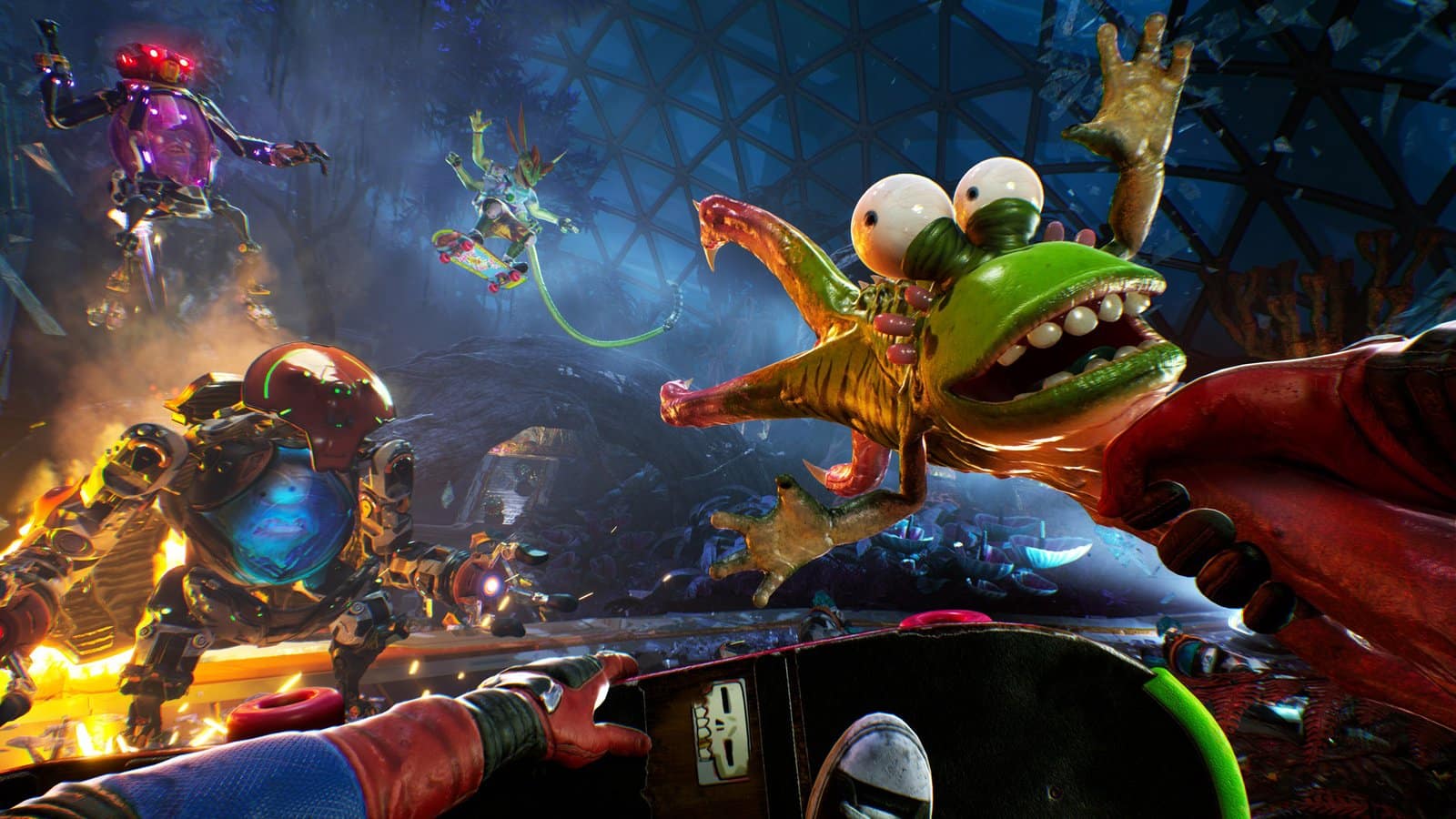
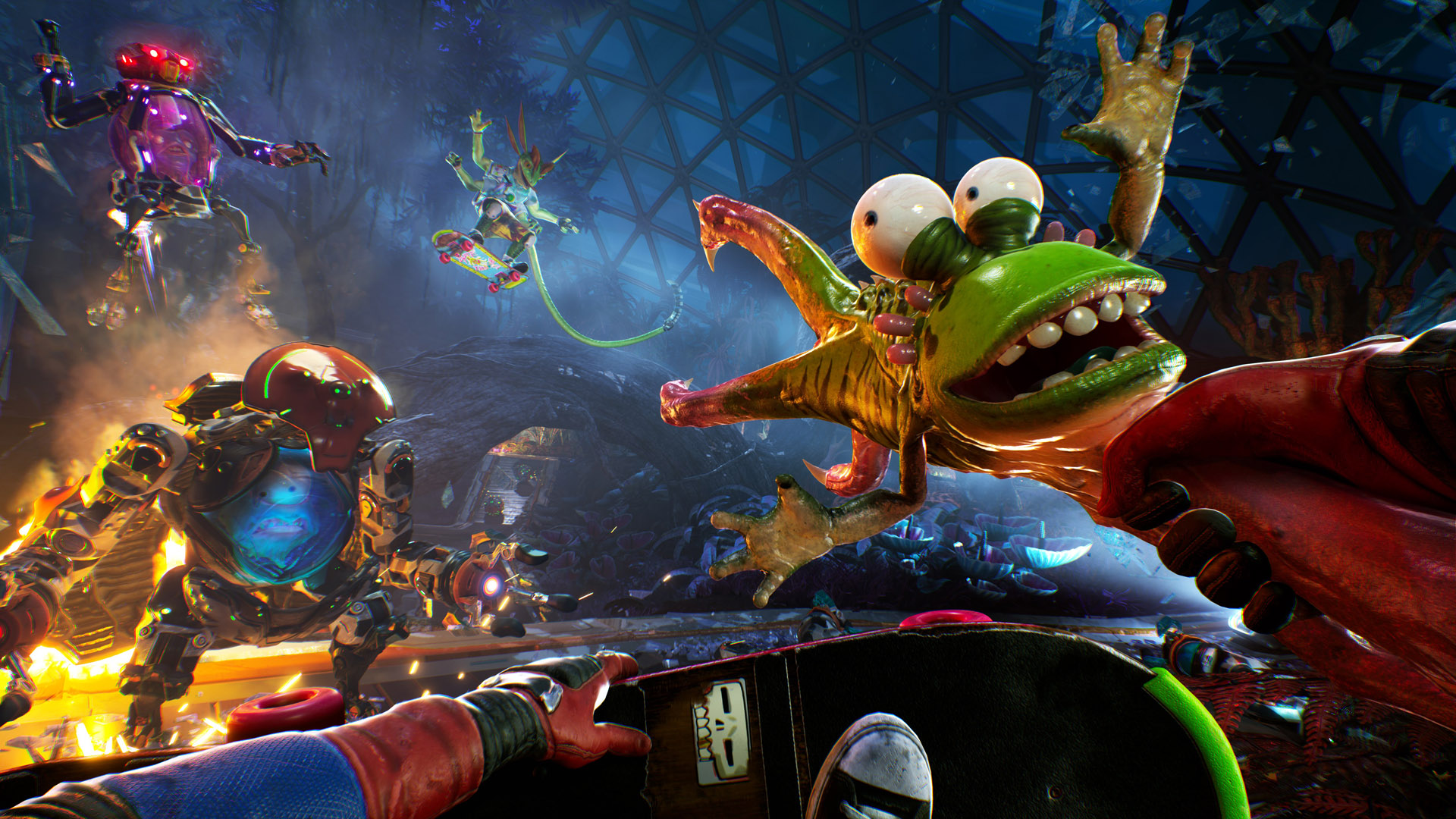
When I first got my hands on High On Life 2 last year, I was blown away by how well it captured the essence of skateboarding. Yes, it’s a video game, so there are some liberties taken with it, but it felt right in a way that feels familiar to skating game fans – even in a totally different perspective and genre. With large, skateable objects meticulously placed, paired with some great first-person shooting thanks to the hilarious Gatlians, it’s a mechanical change that gives High On Life 2 a truly one-of-a-kind feature, something we’ve genuinely never seen a developer try before.
This also makes High On Life 2 feel like a much faster game than its predecessor. By essentially swapping it out for your sprint button, and increasing your overall agility, the skateboard feels like an extra limb you never knew you needed – one that allows you to grind on rails, jump over objects, or even as a projectile against enemies.
Now, with release nearly here, I was able to connect with Chief Design Officer Erich Meyr to talk more about how the idea behind having skateboarding as a traversal (and combat) mechanic within a first-person shooter came about – and it turns out it was something the team had been noodling on since before the first game arrived.
“The earliest inspiration for the skateboard came back on High On Life when Concept Artist Sean McNally drew the bounty hunter riding a roly-poly type of alien,” Meyr tells me. “Unfortunately, a level-specific mechanic like that wasn’t in our timeframe on the first game, but good ideas tend to haunt us forever. When we were brainstorming for High On Life 2, the idea scuttled its way from our collective unconscious, and we thought it would be even better as a normal skateboard that helps ground your character as an Earthling.”
Parkour!
Skateboarding has embedded itself into the world of gaming over the years – there have been countless Tony Hawk games; Skate has returned in force; indie games like Session or Skate Bird bring their own flare to the skate video game genre. Now High On Life 2 is building this out as a first-person experience and is taking cues from games from both the past and the present to help it really feel distinct. But one of the big inspirations isn’t technically a skateboarding game at all:
“Three of us on the dev team were lucky enough to work on Sunset Overdrive at Insomniac Games, and while doing first-person skating is a bit different then Sunset’s grind-heavy parkour, I really wanted to capture a similar environmentally driven flow,” Meyr explains. “While working on Sunset Overdrive I was addicted to traversing across Sunset City; I’d often travel all the way across the city to play my work, instead of using developer shortcuts, just to explore and enjoy the traversal team’s amazing job. When we started seriously considering having a skateboard in High On Life, I knew deep in my cobwebbed soul we should strive for that feeling, even if it inflated the skateboard into something much larger.”
As far as digging into the classics, the team went back and analyzed a lot of Tony Hawk games to figure out what would work (and not work) for first-person skateboarding. For example, Tony Hawk’s controls don’t work as an FPS, but served as a baseline inspiration for what skating should feel like: “It really got me thinking about layering in vert ramps, half pipes, and grinds. I played a ton of Session as well, though as much as I love it for being insanely technical, we were going for a much more simplified control scheme and couldn’t fit in something like their awesome trick system.”
Finding Inspiration from Indies
During the research and conceptualizing phase of High On Life 2, Meyr was surprised to find that there were practically no first-person skating games available, beyond some mods for Skate. Then he stumbled upon an indie game called Griptape Backbone. “It’s very chill and dreamy and got us thinking about how to cheat the board placement so it’s more visible in first person and helps ground you.”
“When we were near the last year of development, [open world FPS] Echo Point Nova came out – I had a blast playing it and loved how they simply replaced sprinting with a hoverboard. We applied that same philosophy to our game (choosing what button to put the skateboard on was giving us no end of grief) and it really made combat on and off the board feel seamless. So, we pulled inspiration from a lot of different games along the whole process. The inspirations were all great references, but it really came down to some very clever engineering, solving a lot of wild design problems, tuning the controls, and a lot of playtesting.”
Once it was settled that skateboarding was going to be a key feature for the next game, the team began to tackle High On Life 2’s more unique challenge – mixing both skating and shooting and making them feel fun to play. One of the largest debates that Meyr tells me about on the team was whether your aim should be independent of your movement direction while on the skateboard.
“For a long time, you could look in any direction while skating, which felt very natural and let you do some crazy moves like circling around enemies while shooting and skating backwards while still fighting,” Meyr says. “However, in playtesting, it meant we kept having to make larger and sparser arenas so you wouldn’t be running into stuff constantly because you’re not looking where you’re going!”
In the end, the team decided to lock the player’s movement to their viewpoint while skateboarding but allow free look while grinding objects – effectively, skating is all about getting to the right place, and grinding is about unleashing hell once you’re there. This simple change made navigating spaces and the overall usability of the skateboard in combat feel much better. Having navigated through a few levels in my time with High On Life 2, I get the trade-off here, as I no doubt would have bumbled into numerous walls and objects if I wasn’t looking in the right direction.
In part, that’s because of how fast the skateboard lets you travel – this is far more than a fancy sprint button, letting you cross huge swathes of a level in a way most FPS games don’t. It adds a major new dimension to combat but, given that the game has a compelling and hilarious story to tell, with tons of performances to capture, it’s also entirely possible for you to accidentally skip past a character or line of dialog if you’re not facing the right way. I asked Meyr how the team tackled this challenge, even in the moments where there wasn’t a narrative beat to adhere to.
“Well, firstly it made storytelling harder as players can now fly past everything as fast as they want! We had to get clever about how we funnel you into important moments to give players time to notice them,” Meyr tells me. “But aside from that, it was also a fun challenge to figure out what kinds of city objects make natural skate elements. One of my favorite moments was when someone put a big octopus mascot in the middle of the city, and we were like, ‘Hey, this is great, but it needs to work with the skateboard because every single player is going to grind on that shit.’ And then we exposed its brain as a bouncer to launch you crazy high. There’s no real story there I guess… we just love making stupid things fun.”
Ride, Shoot, Have Fun, Repeat
Matching that fun with a well-paced game is another element the team tackled when deciding how much influence skateboarding should have on the overall design and pacing of High On Life 2.
“In the first game we typically paced gameplay to cycle between traversal, combat, and narrative beats. The skateboard fit pretty easily into the traversal piece of that formula,” Meyr explains. “Skating has a large influence on the combat aspect of the game, but we didn’t let it take over. In the end, we wanted the game to still have a lot of what makes a traditional shooter feel fun. We didn’t want the skateboard to muddy the FPS experience by having to blow out aim assist or let you move so fast enemies have to do crazy things to keep up with you.”
The game wastes little time in getting me on the board and it isn’t long until I’m unleashing this tandem of skateboarding and shooting in High On Life 2, like sliding across powerlines as I dispatch a variety of alien goons in the opening zoo level. The skateboard never feels like it gets in the way of the shooting; it amplifies it, nudging me to mix it into my newfound ability to reach alien foes on rooftops who would otherwise be inaccessible without it.
The first game already featured a lot of verticality and unique traversal elements thanks to the Gatlians like Knifey and their grapple ability – but the skateboard only intensifies that ambition. Grinding, riding in sewer pipes, and wall riding all create opportunities for unexpectedly complex riding options in the environment. Every level features unique opportunities to test your skills, like navigating across a mix of floating rails and pools, giant balloons to bounce on, and other zany obstacles while traversing the planet ConCon as one such example.
Board riding can also be vital, as highlighted in some of the boss fights so far. With the bounty hunter Sheath, it took place in a large room with slanted, quarter-pipes that run up the walls, making for plenty of opportunities to remain on the move while dishing damage. Or fighting against Brutakis, the mini-boss of MurderCon, the entire zone felt like a skatepark with plenty of ramps, rails, and stairs to navigate. This all feels designed with purposeful intent to keep you moving to help bring a natural fun and flow to the battle.
Letting Go of Your Hands
It’s always a balance to teach a new mechanic to a player while making it not feel like you’re holding up the momentum of the game. Initially, the team did a lot of “hand holding tutorial” tests for the skateboard and found it made for a terrible experience. In the end, they pared the tutorials back until they were just hitting the essentials and letting the player grasp and play with the mechanics on their own time.
“There are elements to the skateboard we don’t teach up front and let you discover on your own, then reinforce in later levels,” Meyr says. “By that point you may have already figured them out and won’t even notice the tutorial, or you will learn them there and think, ‘Holy crap I could have been doing this the whole time, I need to go back and try this in the city!’”
Meyr tells me that, during playtesting, he was relieved to see the concept embraced by the internal team. “I was worried if we leaned fully into skating, it meant we’d need to sacrifice some of the core FPS, but it turned out when the skateboard was treated as an extension of sprinting it really helped naturally juggle between the two. I was also delighted at how much people wanted to do with the skateboard in combat. We came up with bailing on your board and having the board fly and hit enemies, and immediately playtesters wanted to bounce on enemies’ heads and bash into them. So, we made all that work! I’m curious if players will be able to beat the game just using the skateboard once you obtain it.”
Through constant iteration and driven by a passion for skateboarding, the team at Squanch Games have not only built upon the success of their first game but pushed themselves to bring something wholly unique to its sequel – while doing a kick-flip over a bunch of aliens. We can’t wait to get on our board on February 13, 2026, when High On Life 2 launches for Xbox Series X|S, Xbox on PC, and available on day one with Game Pass Ultimate with support for Xbox Play Anywhere.
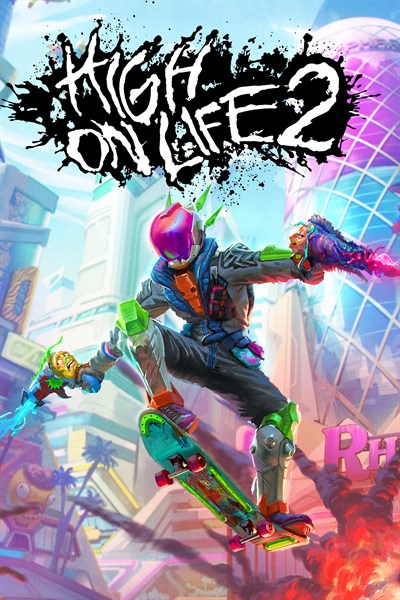
High On Life 2 Pre-order Bundle
Squanch Games, Inc.
$59.99
Pre-order High On Life 2 now to get a “I PRE-ORDERED HIGH ON LIFE 2” hat for select weapons! It doesn’t do anything but if you don’t pre-order you’ll never be allowed to have it! (And the weapons in our game can feel real emotions so if you don’t get the hat they’ll remember it and resent you for it!)
Offer ends at launch.
You’ve done it. You’ve taken down an intergalactic cartel, brought humanity back from the brink of extinction, and hunted dangerous bounties to the far corners of the galaxy. Bounty hunting has brought you fortune, fame and love; but when a mysterious figure from your past reappears and puts a price on your sister’s head, your cushy life gets thrown into chaos.
Do you have what it takes to risk it all and bring down an intergalactic conspiracy that once again threatens your favorite species (humans)?
High On Life RETURNS as you and your beloved rag-tag team of alien misfits shoot, stab, and skate your way through gorgeous, dangerous worlds all across the galaxy to blow up the EVIL pharmaceutical conglomerate hell-bent on putting price tags on HUMAN LIFE!
The post How High On Life 2’s Skateboarding Kickflips the Shooter Genre on Its Head appeared first on Xbox Wire.